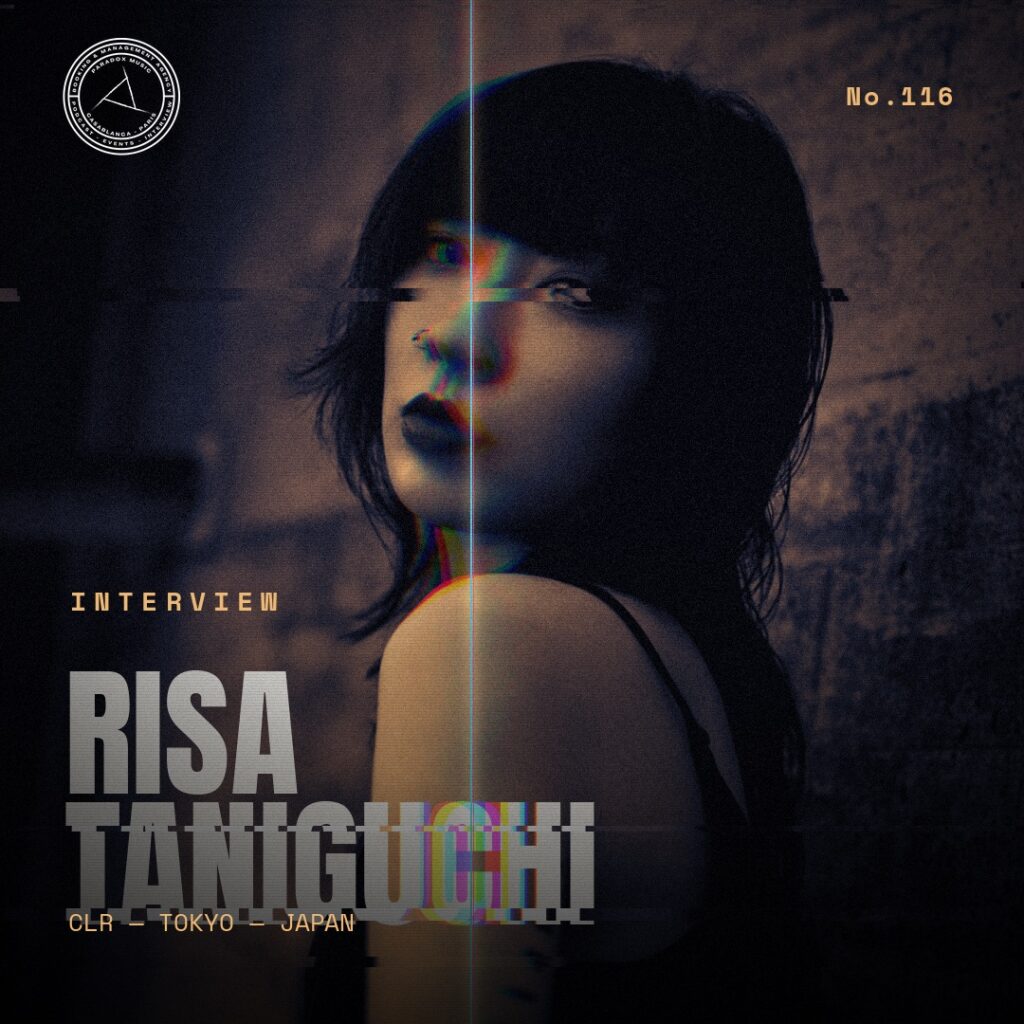
Tokyo to Paris, and a passport that barely gets to cool down. RISA TANIGUCHI has spent 2026 in permanent motion — a fifth EP on CLR with Magnetic, a Paris debut at MIA MAO on Dave Clarke’s invitation, an ADE booking ahead, and a Best DJ nomination at Music Awards Japan, the only woman among five names.
- Hi Risa, thanks for answering our paradoxical questions! 2026 is shaping up to be a huge year for you — between your fifth CLR release with ‘Magnetic’, your Mia Mao Paris debut and your upcoming ADE booking. What have you been up to lately, and what’s the rhythm between Tokyo studio sessions and international touring?
Honestly… my fifth release already?! I still can’t quite believe it myself. When I first signed with CLR, I never imagined I’d end up releasing this much music on such an iconic label.
And yes, my Paris debut was a truly special night. It wasn’t just because it was Paris—it was because the invitation came from Dave Clarke. I wish I could go back and tell my younger self, the student wandering around Paris alone with a backpack and taking photos in front of the Arc de Triomphe, that one day she’d be playing there.
This year has already been incredibly busy with international touring, to the point where it sometimes doesn’t even feel real. Whenever I’m back in Japan, I try to dedicate as much time as possible to making music. I also make a point of dropping by my local clubs to catch up with friends and stay connected to the community.
As for finding a rhythm between touring and studio life… honestly, I think that rhythm has completely fallen apart. Whether I’m in Japan, somewhere in Europe, or just coming home, I’m pretty much permanently jet-lagged! (laughs)
- You were born and are still based in Tokyo, and you’ve often praised the intensity of the local club culture. For our French readers who may have never set foot in Vent, Contact or Womb, how would you describe what makes the Tokyo techno experience genuinely different from a European night?
That’s always a difficult question for me to answer because honestly… everything feels different.
If I had to pick one example, it would be transportation. In Tokyo, public transport basically stops running after midnight. That means going clubbing is a real commitment—you either stay until the first train or find another way home. Because of that, I think people who come out are often genuinely there for the music.
Japan also has a pretty strong drinking culture, so clubs can be a place where people let go of the stress they’ve built up during the week. Maybe that’s part of what gives the dance floor its particular energy.
- The Japanese techno scene has produced incredible artists — Wata Igarashi, Go Hiyama, DJ Nobu, Sapphire Slows, Hoshina Anniversary — yet it still feels under-represented internationally compared to the size of its talent pool. From the inside, what’s the actual reason: language barrier, geographical isolation, structural issues, or something deeper in the culture itself?
I think that is a very good question, and I actually agree with that perspective. There is so much high-quality music coming out of Japan. In many ways, we are very disciplined, and there is a strong sense of craftsmanship here. You can find a lot of work that is absolutely on an international level.
But when it comes specifically to techno, or electronic music more broadly, the scene is still very closely connected to DJ and club culture. And as I mentioned earlier, going to clubs in Japan is not necessarily a mainstream choice. So there is already a certain barrier when it comes to reaching a wider audience.
At the same time, within DJ culture and club culture, it is also true that recognition is not always based purely on the music itself. There are many other factors involved: community, context, visibility, timing, connections, and how people position themselves.
So I don’t think there is one simple reason. It is more like several things overlapping: language, geography, the structure of the scene, and also the way Japanese culture tends to value subtlety and humility. All of that probably contributes to why Japanese electronic music is still under-represented internationally, despite the amount of talent here.
- Being based in Tokyo while building a European career means insane travel rhythms — you’ve even said you feel like you’ve spent more time in airports than your own apartment in 2025. How do you actually sustain that life physically and creatively, and is staying in Japan still a conscious choice rather than a default?
Yes, it really does feel like I’m at an airport almost every weekend this year.
I’m naturally someone who needs a lot of sleep, so to be honest, the travel part of touring can be really tough for me. But once night falls and I step into the booth, all of that disappears. That moment is what keeps me going.
I drink quite a lot, and I wouldn’t say I exercise more than the average person, so I don’t really have any secret for sustaining this lifestyle. (laughs)
As for staying based in Japan, I think it’s half emotional and half strategic. On the emotional side, I simply love Japanese food. I genuinely don’t think I could live without it. I’m not even joking. During hard tours, sometimes the thought of what I’ll be able to eat when I get home becomes my motivation. Of course, I also love discovering great local food when I’m traveling.
But on a more serious note, I do think part of the reason I get certain bookings is because I carry the identity, or the “tag”, of being a DJ from Japan. In cities like Berlin and across Europe, there are already so many artists gathered in one place that you almost bump into DJs just walking down the street. In that kind of environment, I think it would be very difficult to feel special or stand out in the same way.
- You were recently nominated for the Music Awards Japan 2026 in the Best DJ category — a major moment for techno in a country where electronic music is rarely awarded at that level. What did that nomination represent for you, and for the scene more broadly?
When I first started DJing, Japan was still living under what many people called the “no-dancing law.” I personally knew club managers who were even arrested simply for letting people dance.
That’s why the fact that Music Awards Japan, the country’s biggest mainstream music awards, now has a Best DJ category is such a significant milestone. For a long time, DJs and nightclubs existed in the shadows of Japanese music culture.
We owe this moment to the people who came before us—the pioneers who fought to reform the Fueiho law, and everyone within the club scene who kept these spaces alive despite incredibly difficult circumstances.
Out of what must be tens of thousands of DJs across Japan, being selected as one of just five nominees—and the only female DJ among them—was deeply meaningful to me. I didn’t see it as recognition of just my own work, but as a reminder of how far our scene has come.
- Your relationship with CLR started in November 2022 with the ‘Acid Flesh’ EP alongside Black Asteroid, and has grown into a real partnership through ‘So Loud’ (May 2024), ‘Wakes From Coma’ (June 2024), ‘Break It’ (August 2025), and now ‘Magnetic’ landing on June 26th — your fifth release on the label. Looking at this trajectory, how has Chris Liebing’s role in your work evolved — from a label head who took a chance on you to something closer to a creative collaborator ? After Shanghai came Berlin, then finally Paris. Each city has its own techno DNA. How did each chapter leave its imprint on the artist you are today?
I’m incredibly grateful to Black Asteroid, because he became the bridge between me and CLR, a label I had admired for such a long time, and of course Chris Liebing himself. Working with Black Asteroid also pushed me creatively. Through our collaboration, he helped bring out the full potential of my music and gave me new perspectives on my own sound. It was a truly inspiring experience, and I learned a great deal from it.
Chris is still very much the head of the label, but he is also one of my favorite DJs in the world, and one of the people who understands my music better than anyone. His feedback is always honest and insightful, and I trust him deeply as both an artist and a mentor.
- The ‘Magnetic’ EP arrives with two tracks of contrasting energies: the title track builds on thumping kicks, distant bell tones and cavernous sub-bass for something cinematic and patient, while ‘Masks’ pushes into more extroverted territory with hammering percussion, fractured synths and vocal yelps. What headspace were you in when writing them, and what does that duality say about where you stand as a producer right now?
Honestly, I don’t think very much about philosophy or concepts when I write music. I usually just follow my instincts and let the track come out in one flow. If anything, I discover what I want to make by jamming with myself rather than starting with a fixed idea.
If I had to describe the difference, I’d say Magnetic reflects more of my darker side, while Masks is a track where my attention was directed more outward than inward. It’s less about expressing myself and more about responding to something beyond me.
- You once said releasing on CLR comes with “no room to hide” because the catalogue’s standards are uncompromising. Now that you’ve delivered five EPs on the label, has that pressure transformed — into something more familiar and trusted, or does each new release still feel like starting from zero?
With every release on CLR, I’ve actually felt less pressure, because each one gives me more confidence that Chris genuinely believes in my music. Before my first EP on the label, I put an enormous amount of pressure on myself. I’m a very goal-driven person, and all I could think was, “I have to release on CLR no matter what.”
Now, whenever I send Chris a demo, the feeling is completely different. Instead of anxiety, I’m excited. I’m curious to see how he’ll interpret where my music is today, and that has become one of the most enjoyable parts of the process.
- On March 14, 2026, you played your first Paris date in years, invited by Dave Clarke to his “Off The Grid” residency at Mia Mao — a 2,300-capacity venue you publicly admitted you were surprised even existed. Now that the night is behind you, what did playing Paris again actually feel like, and is there a moment from that set that will stay with you?
Honestly, it was one of the best nights of my career. A lot of my friends who live in Paris came to the show, and before this year I had only visited the city once—as a student, wandering around on my own with a backpack.
France has always been a special place for me. I’m a certified wine professional, my father was a chef who specialized in French cuisine, and I even studied French at university. So coming back to a country that means so much to me, this time to do what I love most as my profession, was incredibly emotional.
During my own sets I’m always completely focused, so I don’t really have time to get excited in the moment. (laughs) But Dave’s set afterwards was absolutely incredible. I spent the whole time dancing on the floor like everyone else.
- How did your relationship with Dave Clarke actually start? You once posted about going to an izakaya with him in Amsterdam, which is a beautifully unexpected image. What’s the version of Dave Clarke few people get to see, and what has his support changed in your career?
As everyone knows, Dave is a true legend. In Japan also, he’s been famous for decades, and to me he always felt like someone from another world. After I started releasing on CLR, though, he would often leave kind comments on the promos, and I kept hearing him play my tracks in his DJ sets. I loved the way he “cooked” my music into his sets. We’re lucky to live in the age of YouTube, because I could actually watch those moments. When I happened to be touring in Amsterdam, I finally worked up the courage to send him a DM. I honestly thought there was a good chance he wouldn’t reply, and that would have been completely understandable. But he did reply.
When we met, I was pretty nervous to be honest. But, he couldn’t have been more down-to-earth. We had a Guinness at a pub before he took me to his favorite Japanese restaurant in Amsterdam. We talked for hours about his roots, music, and life. I had imagined someone much more intimidating, but he was incredibly warm, funny, and easy to talk to. Time just flew by. Simply knowing that someone like Dave Clarke genuinely appreciates my music has changed my confidence as a producer. That encouragement continues to have a hugely positive impact on the way I make music today.
- You focus heavily on drums in production — kicks, snares, hi-hats. For an artist who came from classical melody, that’s almost counter-intuitive. When did rhythm become the heart of your music rather than harmony?
You’re absolutely right—I barely make use of my classical or piano background at all. (laughs)
Looking back, I wonder if my fascination with Debussy as a student actually made me less interested in traditional harmony. What drew me into club music wasn’t melody; it was rhythm.
I fell in love with electronic music because of drum beats, so it feels completely natural that drums are still the center of my production today. My emotion rarely responds to a melody first—it’s almost always a beat pattern that makes me move.
- Few people know you’re a certified J.S.A. wine expert with a WSET Level 3. How does that parallel passion influence — or balance — your life as a touring DJ? And is there a wine that pairs particularly well with a late-night session in the studio?
Honestly, I often ask myself why I spend so much time studying something that has nothing to do with music. (laughs) Before my WSET exam, I had just come back from playing at Mia Mao in Paris. While everyone else on the long-haul flight was sleeping, I was sitting there with my laptop studying for the exam.
So I wouldn’t say wine balances my music career—I probably should have spent more time making music instead! I just have a personality where, once I become interested in something, I want to dive into it completely.
I almost always work in the studio late at night, and to be honest, it’s rarer for me to produce without a glass of wine than with one. (laughs) Since studying wine seriously, I’ve actually become less attached to any single style. What excites me now is discovering something different every time I open a bottle. That said… after exploring so much, I think I’ve come full circle. Pinot Noir is probably still my favorite.
- What Japanese artists and labels should our French readers absolutely keep on their radar in 2026? Names that haven’t yet crossed over but deserve to?
As I mentioned earlier, Hoshina Anniversary is someone I deeply admire. He’s also been a mentor of mine, giving me invaluable feedback on my productions over the years. To me, he’s one of Japan’s greatest electronic music artists. He has a sonic identity that belongs entirely to him—when you hear one of his tracks, you immediately know it’s Hoshina. I think everyone should experience his music.
- And on the international side — any non-Japanese artists, releases or labels currently catching your attention?
Without a doubt, I continue to draw a huge amount of inspiration from SPANDAU20 and everything FJAAK are doing. Not only do I love the music they release, but I also think they’ve built one of the coolest label identities in electronic music today.
- Beyond Magnetic and the ADE 30 Years edition, can you give us a glimpse of what’s next for Risa Taniguchi — releases, collaborations, gigs, or even non-music projects?
Recently, I’ve been spending more time composing for other people and for projects beyond my own artist career, and I’ve come to really value those opportunities.
I’ve written techno tracks for an idol group, composed music for fashion runway shows, and supported the live production of another artist. Being part of moments that couldn’t happen through my own project alone has been incredibly inspiring, and every collaboration teaches me something new.
I’d love to continue creating music beyond the world of techno. And if time ever allows, I’d also like to make music purely for fun again—especially bass music, which was one of my earliest musical roots.
Thanks a lot RISA, we hope to see you very soon somewhere, keep the good vibe on!
Love and respect