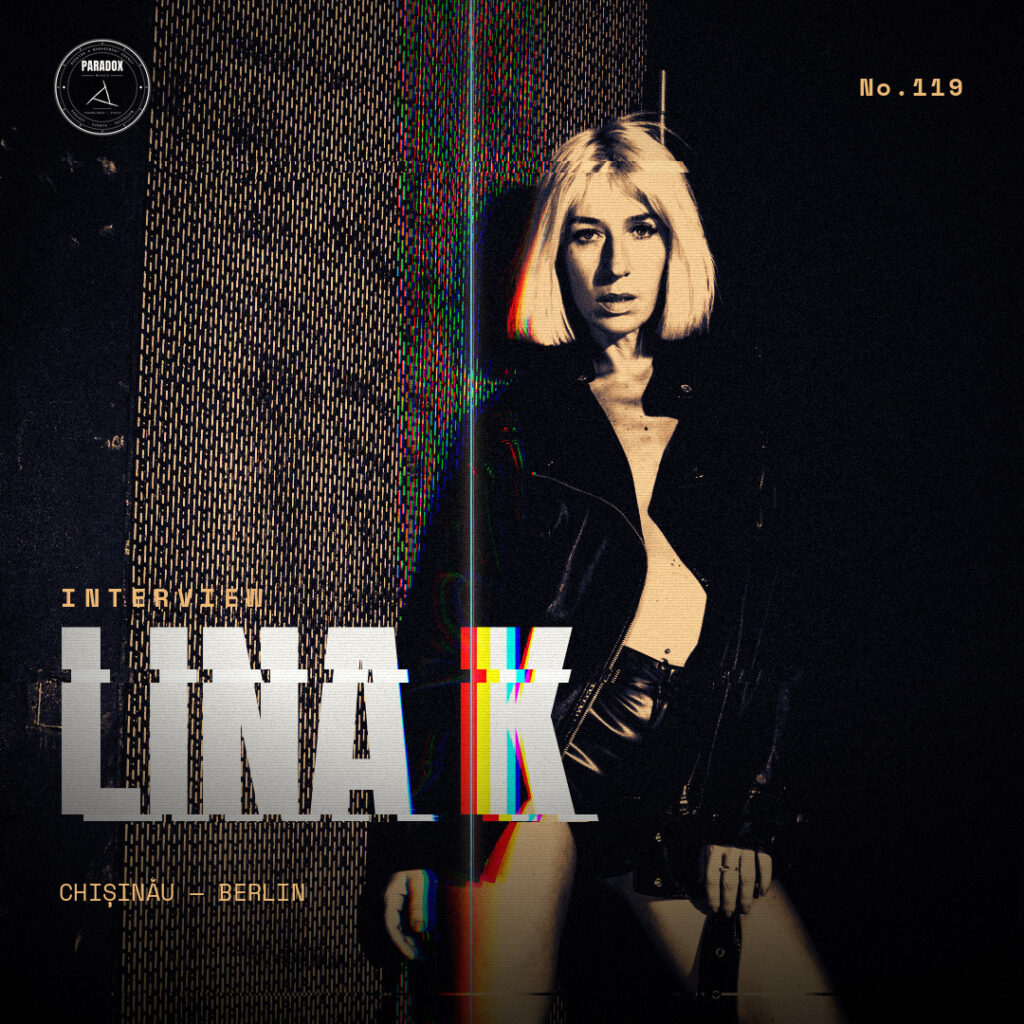
From Chișinău to Shanghai to a whole new chapter in Europe — Lina K has spent fifteen years building Chinese techno from the inside, and 2026 is her reset. A dancer before she was a DJ. Founder of Techno Train, the party-for-friends that became a map of techno across eleven Chinese cities. The mind behind Techno Is A Woman.
- Hi Lina, thanks for answering our paradoxical questions! 2025 was a pivotal year for you with releases on Rave The Planet, MODE, Synthlab, Art Bei Ton and more, and 2026 kicking off with your new EP landing on Sotor Records (SOT14). What have you been up to lately, and what does the rhythm look like between Shanghai late-night residencies, studio sessions and international touring?
2026 has marked a major turning point in my life and career. After more than 15 years based in China, I’ve relocated, opening a completely new chapter both personally and artistically. Musically, I’m focused on finishing my debut album, with another release coming soon on Art Bei Ton. This year has also been about finding a new creative rhythm — balancing motherhood with studio work, productions, and performances, while continuing to develop my sound and direction as an artist. It’s a period of transition, growth, and exploration, and I’m excited to see where this new chapter takes me.
- You were born in Chisinau, Moldova, into an eclectic diet of techno and deep house. What is the memory of Moldovan electronic music culture from your early years, was there already a scene, or did you have to build your own soundtrack from imports and record digging?
Back in the day, techno wasn’t really that present in Chișinău. If there were big raves, they were usually more trance-focused, while in the clubs it was mostly minimal and vocal house.
I think one of the biggest influences on me was Kazantip Festival in 2001. I remember hearing the DJs there and thinking, What is this music? It made me really curious to find out more about what they were playing.
But I actually discovered techno properly much later, when I was already living in Shanghai. I was already DJing by then, and I remember going to one of my DJ teachers, who was from the UK. He was playing this really trippy, hypnotic music, and I asked him, “What is that?”
He said, “That’s techno.”
And I was like, “Okay, I want to play this.”
- Very few DJs make the leap from Eastern Europe to China. What actually brought you to Shanghai, and did you land there already with music in mind, or did techno become the anchor after you arrived?
I came to China on a dance contract, but for some reason I really wanted to learn how to DJ. So I found some people who could teach me, and everything started very naturally from there, with my first gigs.
At the time, I was working both as a dancer and a DJ, but eventually it became too much to do both. I decided to leave dancing and focus on music full-time, and I’ve been a full-time DJ since 2012.
- Before DJing, you were a dancer. That is a physical relationship to music most producers do not have. How does that dancer body memory still shape the way you build tension in a set, and the way you read a floor from the booth?
Being a dancer in the past really helped me understand the logic behind mixing music quicker, because it’s based on a similar principle. It also helped me learn how to feel the crowd better.
I dance a lot when I’m DJing — it helps me release stress while playing. But if I’m dancing way too crazy behind the decks, it usually means I’m nervous as fuck. Hahah.
- Techno Train started in 2014 as “just a party for friends” and has since travelled to Shanghai, Beijing, Hangzhou, Chengdu, Kunming, Nanjing, Dali, Ningbo, Shenzhen, Guangzhou, Chongqing. It became a real map of Chinese techno. Looking back at that first night, what was the actual trigger, and could you have imagined it would grow to that scale?
The idea behind Techno Train was really just to create a space where I could book the DJs I wanted. I had a lot of friends who were DJs, and somehow they would never end up playing on the same lineup, so I thought, “Let me just make one,” and booked all of my friends.
I really didn’t expect it to become such a long-running project, but here we are, 12 years later. It’s not running in Shanghai anymore, but it’s still going strong in Beijing. A huge thanks to Wildkats for keeping the project alive and making it very, very successful at the moment.
- Bringing international artists to China involves specific challenges most European promoters never face: visas, censorship, logistics, and sometimes cultural translation of the music itself. What is the hardest booking you have ever pulled off, and what did it teach you?
To be honest, I’ve never really had any issues. When you’re based in China, you learn how to do everything properly and follow the rules, so I never had any problems.
- “Techno Is A Woman”, the name itself is a manifesto. Where does that phrase come from, and what was the specific moment that made you say: “this needs to exist, and I need to be the one to build it”?
The name came from a friend of mine who posted a GIF from Nina Kraviz on some WeChat group and said the phrase “Techno IS a Woman,” and I said this is a great name for a party, and can I use this?
Techno Train was already running, and every March has International Womans Day, spring is a new beginning, and I always had a female-only edition at that time. People loved the concept, so I decided to carry that on forward.
- Being a female DJ who is also a promoter and curator, you sit on both sides of the fence. What is the difference you actually see between how the scene talks about supporting women, and what happens behind the scenes when a line-up is being confirmed?
In China, I’ve never felt the pressure to be a female DJ, but in Europe, yes. But here, with the majority of bookers and clubs run by men, they don’t seem to pay as much attention to female artists unless pressured to do so, so they don’t even look into you sometimes.
We need to have more female bookers and booking agents to even things out.
- Landing on seven labels in 2025 (Rave The Planet, MODE, Synthlab, Art Bei Ton, Ambient Sleepers, Genom Sequence, Paralelo) is a genuine breakthrough moment. Was there a specific track or demo that opened the doors, or is it more the result of years of quiet groundwork?
The remix I did for Pfirter gave me a lot of visibility, but the track for Art Bei Ton really helped me out.
- Full disclosure for our readers: SOT14 lands on Sotor Records, which is part of the Paradox family, so we will let you tell the story from your side. How did this collaboration come about, and what direction did you push your sound in for this EP?
It wasn’t really a planned EP, actually! I sent my information with a link to my unreleased music for booking at the club and they heard that demo package and offered me the chance do a release with them from there. I don’t produce music for a specific label, I just create for myself and see where things land.
- Since 2023 you have been expanding into Europe: Blackmarket and Grelle Forelle in Vienna, Insomnia and About Blank in Berlin, Radost in Bratislava, and the HOR Berlin session. Which of these European nights genuinely felt like a turning point, and what is the biggest difference between playing there and playing in China?
Having played in China for so long, I needed to break out and enter the European market. The reception I got on my first tour in the EU was shocking to me at how appreciative and attentive they were to the music and the artist, which is not the case in China. The maturity level of everything was elevated and it really made me want to spend more and more time there.
- Do you have a precise moment in your career that you will never forget, one that genuinely changed your trajectory?
The most memorable gig ever was YinYang Festival, playing a sunrise set literally on the Great Wall of China. But one that changed my trajectory goes back to this previous question about my first European trip and tour.
- As a promoter and label-released artist, you receive tons of demos every week. What advice would you give to a young Chinese producer in 2026 who is trying to break into the European circuit, and what is the mistake you keep seeing over and over?
I don’t see many mistakes, but I’d say, not just to Chinese producers, but to ALL producers – keep making your thing, don’t conform or try to make music for other people, always do it for yourself. Don’t be ashamed or afraid of rejection – you will get rejected, more than once – but it isn’t personal and you don’t need to take it that way and have it ruin your motivation.
- Beyond the SOT14 EP and your 2026 release schedule, can you give us a glimpse of what is next for Lina K, Techno Train and Techno Is A Woman? Any releases, tours, or collaborations you can tease?
Techno Is a Woman doesn’t exist as a project anymore at this point in time, but that could change in the future. Techno Train is still running in Beijing without me being there, but my partner from Wild Kats is doing a fantastic job of keeping that one operational. We recently found a new location that is an actual train carriage so we’re motivated more and more by that opportunity.
As for releases, I have my own album coming out on my own label, which will be the launchpad for that project, but I also have another release on Art Bei Ton, which is a split EP with Andrea Zapata, which I am very excited for.
Thanks a lot LINA K, we hope to see you very soon somewhere, keep the good vibe on!
Love and respect