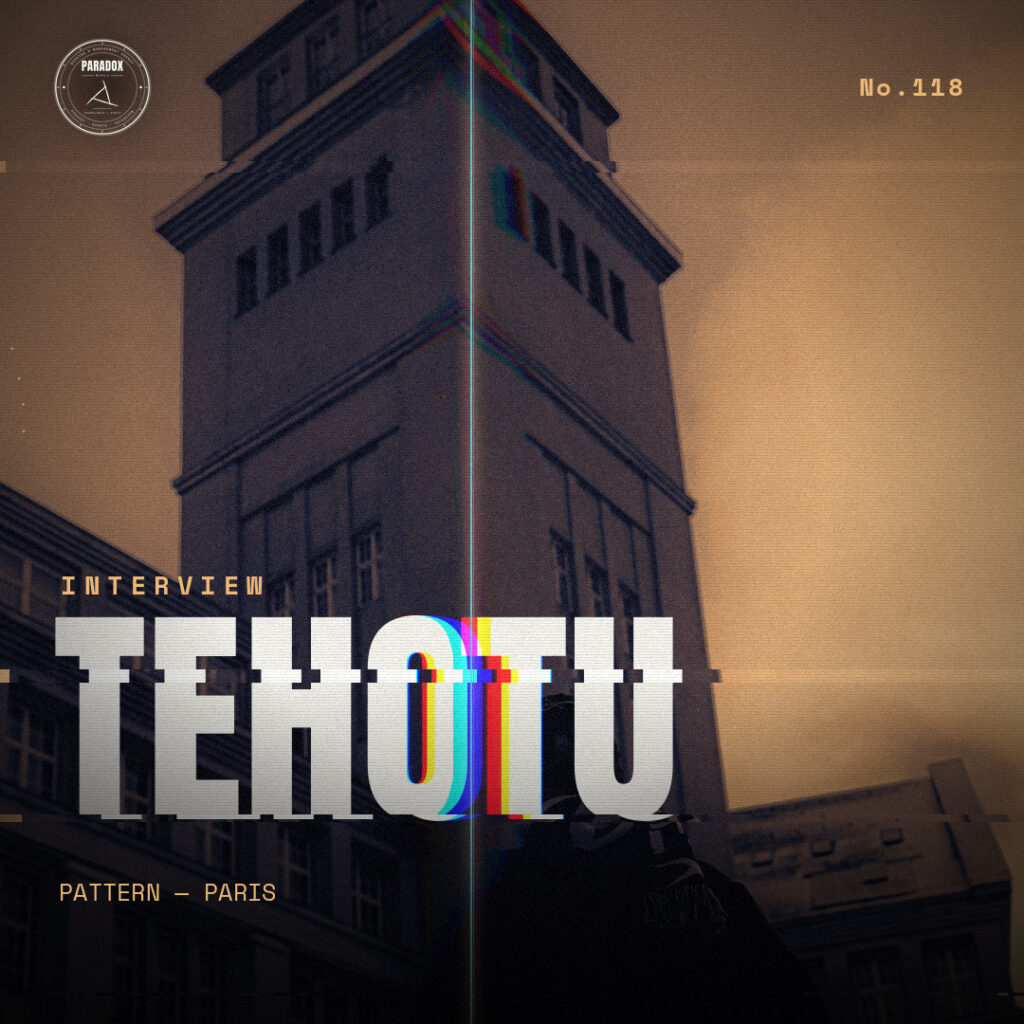
Ten years in Berlin, a metal foundry in Ivry-sur-Seine, and a year off the road that reset everything. Tehotu moved there at 19, with two or three years of production behind him. He calls that period a form of therapy — the more he evolved as a person, the more the music followed. A decade later, health issues forced him to stop. He came back with Pattern rebuilt in Paris, an EP on Gareth Wild’s Ear To Ground, and a much sharper idea of what he wants this culture to look like.
- Hi Tehotu, thanks for answering our paradoxical questions! What have you been up to lately, between Pattern Radio, Sinxergy, the studio and touring ?
I moved back to France a little over a year ago after discovering that I was facing serious health issues. This period forced me to put my career on hold and focus on myself. Looking back, I believe this break was necessary. Beyond the illness itself, I think that as an artist, it is important to know when to step back in order to find new energy and a new perspective.
When you evolve in such an intense scene as electronic music, with all the pressure that comes with it, it can be difficult to slow down. But taking this distance allowed me to rethink my way of creating and the direction I wanted to give to my projects.
It was also during this period that I decided to move Pattern to Paris, into an abandoned metal foundry in Ivry-sur-Seine. For several months, we worked on transforming this space into a true creative environment, with a new team and a strong sonic identity built around a new sound system. The goal remains the same since the beginning: to defend a personal vision of this culture and create a space for expression that reflects it.
Sinxergy was also put on hold during this period. Today, we are in a phase of rebuilding, with many new projects in preparation: developing the radio further, potentially bringing the label back, but also exploring new formats and ideas.
After many years within this scene, my desires are naturally evolving. I am still deeply connected to the club environment, but I am increasingly drawn to different experiences, such as performances, exhibitions, and sound and visual installations. I am currently working on a project using TouchDesigner for a gallery in Paris, as well as another project in a studio in Berlin. For me, this is a way to explore new forms of expression beyond the traditional club format.
Ultimately, this period allowed me to redefine my priorities and build projects that are more aligned with the vision I have today.
- You’ve been based in Berlin for about a decade now, but you grew up in the French scene. What pushed you to relocate, and looking back, what did Berlin give you that Paris couldn’t have offered at that time?
To be precise, I would actually say that I grew up in Berlin, if we can put it that way. I moved there when I was 19 years old, and I had only been making electronic music for two or three years at that time. So Berlin is really where I developed myself as an artist.
Before moving there, I was already connected to the French scene. We had created a small club in the southwest of France, and later built a 1,700-square-meter warehouse space with my team. Through the artists we invited at the time, including some residents from Berghain, we had already started building a connection with Berlin and its scene. Beyond that, I think anyone deeply involved in electronic music culture inevitably has some kind of relationship with Berlin, because the city has had such a profound influence on this culture.
After facing several administrative closures with our project, I quickly discovered how difficult it could be to develop nightlife initiatives in France. It made me question where I truly belonged and where I could continue building something around this culture.
At that point, moving to Berlin felt like the natural next step. I wanted to challenge myself, leave my comfort zone, and experience this culture from the inside, in one of its most influential places. Looking back, I think this decision was the right one, and time proved it.
Berlin gave me much more than just a place to make music. It gave me another way of seeing life, creativity, and artistic expression. It shaped my values and my approach to music.
I often compare this period to a form of therapy, because when you connect deeply with your creative practice, you realize that your music is intrinsically linked to who you are. I quickly understood that the more I evolved as a person, the more my music evolved with me. I wanted my music to reflect who I was, and through that process, working on my music became a way of working on myself.
Ultimately, Berlin transformed my activity as a DJ and producer into something much deeper than just a career or a passion. It became a way of understanding myself.
- The French techno scene has gone through major shifts in the last ten years — the rise of new venues, the explosion of collectives, the international visibility of French artists. From your dual perspective (a French expat in Berlin, but still very active in France), how do you see the French scene in 2026?
I find the French scene incredibly interesting, especially because I first experienced it from Berlin. Back then, there was this huge group of French artists living there, all extremely talented, and many of them have now become leading figures in electronic music worldwide. Most of them are still close friends today, and seeing their journey has been really inspiring.
When it comes to the artists themselves, I think the French scene is doing extremely well. French artists are definitely making their mark internationally, and many of my friends are now playing in some of the best clubs around the world, including Berghain.
However, I think the French scene can sometimes be more complicated to approach from an organizational and community perspective. From my experience, I feel there is generally more caution and hesitation in France, especially towards things or people that are not already familiar.
When I came back to France and started approaching artists and building projects in a similar way to what I experienced in Berlin, I noticed a different dynamic. There is more distance, probably because electronic music culture is still not perceived in the same way in France. The culture is less established, less integrated into society, and because of that, there is perhaps less trust and less understanding around the ecosystem.
I think this also comes from the fact that many artists and collectives have experienced events that were not always well organized or professional, so naturally, people become more cautious. In France, before someone trusts you, you often need to provide more guarantees and prove your credibility.
In Berlin, because the culture is so deeply rooted, a booking proposal or a new project can sometimes happen with much less friction. There is an existing understanding and a shared reference point. In France, I feel that you sometimes need to reassure people more and explain your vision in greater detail.
Maybe another difference comes from the social environment itself. Berlin has always been a very international city, full of people who moved there and are constantly looking to connect, create, and discover new things. In France, especially when you return to your own country, people can sometimes be more attached to their existing circles and naturally more cautious about opening new doors.
That being said, artistically speaking, I think the French scene is incredibly strong right now. The level of talent is undeniable, and seeing so many French artists representing themselves internationally shows how much potential this scene has.
- You launched Pattern in 2021, in the middle of a still-fragile post-pandemic Berlin. What was the founding intuition behind Pattern, and why a radio rather than another club night or another label at that exact moment?
Pattern was actually not the first radio project I created. The idea of Pattern came after the pandemic, during what was almost the golden era of streaming radios. It was also around the same time that platforms like Hör were emerging.
But my first experience with a streaming radio actually goes back much further. Shortly after the administrative closure of the first club we had built in France, when I was around 19 years old, I decided to create Droomface Radio.
The concept behind Droomface radio was quite simple but very experimental for the time: I invited artists to play without announcing their names beforehand. They would perform anonymously, and we would only reveal who they were afterwards. The idea was to remove the influence of reputation and let people judge the music purely for what it was. We all know that an artist’s status and popularity can sometimes influence the way people perceive a performance.
I continued this project after moving to Berlin. When I arrived there in 2015, I didn’t have a studio, so I literally built the radio in my own apartment in Kreuzberg. I was hosting artists in my living room, filming the sessions there. I even had artists traveling from other cities, including Amsterdam, just to come and play in my apartment in Berlin. It was really the first time I experimented with what a streaming radio could become.
A few years later, after the pandemic, I met Franck aka Heka and I proposed to him to join the team an lauch the project together. On paper, a streaming radio seems quite simple: a space, a camera, a sound system, and decks. But we quickly realized that behind the scenes, it required an incredible amount of work, especially with the pace we wanted to maintain.
The bigger the artists became, the more we became connected to the core of the Berlin scene, and the more international the project became, the more the structure had to evolve. That’s why we changed locations several times, eventually bringing the radio to Paris.
And to answer your question about why a radio instead of another club night or another label: actually, we didn’t really choose one over the others. At that time, we were doing all three. We had the radio, our own club events in different Berlin venues such as RSO, Oxi or Suicide and of course Sinxergy, which was my own label project.
For us, Pattern was never only about broadcasting music. It was about creating a platform, a meeting point, and a space where we could express our vision of electronic music culture.
- Volster (Secession) wrote that he first met you while doing a Pattern web show, and that this is what eventually led to your EP “From Now On.” Has Pattern become a place where real artistic relationships are built — and can you share another encounter that came out of it?
I have many examples, but to start with Volster, we actually met physically for the first time at the radio. Before that, he had discovered me through my social media, after seeing a completely random video of one of my productions. He reached out and asked if I could send him some tracks.
The funny thing is that one of the tracks that ended up having the biggest impact, “Hold The Line,” had actually been produced almost a year before I met him. At that time, I had never really approached any label or sent my music around. I’ve always found it difficult to actively reach out to labels and promote my own work. Most of the time, things happened naturally through encounters and conversations.
That was also the case with the EP. I remember hesitating a lot before sending it to him, without knowing that it would eventually connect with so many people.
More generally, Pattern has always been a place where artistic relationships could naturally happen. One of our main goals with the radio was to highlight artists that we felt were not getting enough attention. Because, in reality, many of the artists who are doing some of the most meaningful work are often the ones who don’t play very frequently. Sometimes I even joke that if an artist doesn’t play much, it might actually be a good sign — because there are so many incredible artists building this culture quietly without necessarily being in the spotlight.
The radio gave us the opportunity to meet these people. I have always been attracted to meeting artists who have more experience than me because I’m constantly looking to learn.,
We had the privilege of meeting legendary artists from different generations and backgrounds, from Berlin artists like Alexander Kowalski Roseen Don williams Roseen and many others, to Detroit pioneers such as DJ Scan7, who came to the radio as much as Eduardo de la calle who I played with B2B a the radio. We discovered countless emerging artists from all over the world, as well as artists we deeply respect.
What Pattern taught us through these encounters is that it’s not only about financial resources or the size of a platform. What really matters is the way you defend your vision. Artists recognize that. A true artist, whether they are famous or completely unknown, will always connect with another artist who approaches their work with the same level of sincerity and passion.
- Sinxergy has hosted releases from Ocktawian, Jeroen Search, Pushmann, Atonism, and others. What’s the editorial line you defend at the label, and how do you decide what fits in or doesn’t?
With Sinxergy, the starting point has always been coherence. I wanted every release to feel like it belonged to the same artistic vision. I’ve always been deeply drawn to minimalist techno, although “minimal” has become such an overused term that it barely reflects what I’m trying to express anymore. It’s probably still the closest word we have, but it often points to something quite different from what I have in mind.
The music I release on Sinxergy is built around the idea that a track can be incredibly powerful precisely because it contains so little. It’s a true less is more philosophy. I often describe these records as timeless because they’re memorable through subtlety rather than force. Instead of relying on constant impact or density, they leave a lasting impression with only a handful of carefully chosen elements.
This is the kind of music that shaped me as both a listener and an artist. It’s the music that surprised me the most in places like Berghain and other clubs in Berlin, where exceptional sound systems allow these subtle details to fully come alive. In that environment, restraint becomes incredibly powerful.
That’s also why Sinxergy naturally gravitates towards more experienced artists. It takes a certain level of maturity to make a track compelling with so few elements. Finding that balance is much harder than filling every space, and when it’s done well, that’s what gives a record its timeless quality.
What’s interesting is that even after only a few years, my expectations for the label have already changed significantly. Looking back at the previous questions, I realise that my vision has evolved just as much as my own relationship with music. Everything moves incredibly fast, and while this was the intention behind Sinxergy when I started it, I’m sure it will continue to evolve in the years to come.
- You’ve been described as a “Techno Swiss Knife” — DJ, producer, label owner, radio host, art director. How do you balance all these roles without diluting any of them, and is there one you secretly enjoy more than the others?
As I mentioned earlier, this is why I often compare my creative journey to a form of therapy. Because ultimately, everything is connected.
Being an artistic director, a DJ, a producer, running a radio, managing a label all of these roles come from the same place. They are different ways of expressing the same vision. At some point, you naturally want everything around you to reflect the values and the identity you are trying to build.
That is also something I would encourage younger generations to explore: when you truly love what you do, don’t be afraid to experience different aspects of it. Each role teaches you something about yourself and helps you grow in the others.
For me, developing as a DJ and producer in Berlin, surrounded by so much artistic inspiration, naturally helped me develop my skills as an artistic director. Because when you are a producer, you are already the artistic director of your own music. You are creating a world around your sound. So naturally, when you start creating events, labels, or platforms, you want them to carry the same identity, something that is your own.
Berlin also taught me a lot about the importance of creating spaces built around respect and safer space principles. It changed the way I think about events and communities.
I also learned the importance of visual identity. At the beginning, as musicians, we focus mainly on sound. But we sometimes underestimate how powerful the visual side is. Before people even listen to a record, they “listen” the artwork. The image becomes the first connection with the music. Working on Pattern and on different projects helped me develop that sensitivity and understand how important it is for the visual and the sonic worlds to be connected.
The only area where I sometimes felt a conflict was production itself. Making music requires a lot of time alone, almost like being a studio engineer or a geek, spending hours isolated with machines. That can sometimes feel opposite to being connected with people and the scene.
But in the end, I realized that my external activities were actually feeding my production. The human experiences, the encounters, the artists I met all of that was bringing something back into the studio. I even reached a point where I struggled to make music if I wasn’t connected to the outside world.
So I don’t feel like these different activities diluted each other. Actually, they strengthened one another. Each role helped me improve the others, because they are all connected to me.
- You’ve just released a new EP on Ear To Ground, Spearheaded by label boss Gareth Wild. How did this signing come about, and what does it mean to you, as a French expat based in Berlin, to land on a label so deeply rooted in the British techno tradition?
The encounter with Gareth happened once again through my social media. He reached out to me because he was interested in doing an EP together.
Of course, I was extremely honored because Gareth is an artist I have respected and followed for many years. In fact, when I first arrived in Berlin, I was listening to some of his productions, so his music was already part of the soundtrack of that period of my life.
Having the opportunity to release an EP on his label was a very special moment for me. It was also the first time I released music on a London-based label, and especially on the label of someone who is one of the strongest representatives of the current London electronic music scene.
But the relationship went beyond just making music together. I invited Gareth to come and play in Paris on September 18th, where we will do a B2B together, and we will also welcome him for an Earth To Ground showcase at Pattern.
For me, this kind of connection represents one of the most beautiful things that can happen in electronic music: an established artist with years of experience connecting with an artist from a younger generation. It creates a bridge between experience and new vision, while being connected through shared values.
I think this kind of exchange is something that is becoming increasingly important. There is sometimes a gap between generations, with some established artists struggling to connect with the current scene, while younger artists are looking for guidance and inspiration.
When artists from different generations come together and share knowledge, it creates something much more meaningful than just a collaboration. It highlights the importance of transmission, openness, and sharing values that are essential for the future of our culture.
- Joining a catalogue that already includes Jonas Kopp, Phase, Truncate, UVB and Ness is no small thing. What direction did you push your sound in for this EP, and is there a specific track on it you’re particularly attached to — and why?
One funny thing about this EP is that I actually receive quite a lot of requests to make EPs, and surprisingly, it’s something that can create a lot of pressure for me.
When someone asks me to produce specifically for a project, I sometimes find it harder to create because I start thinking too much about the result. I become less spontaneous, and the process becomes heavier. Usually, even having four or five new tracks that I genuinely feel ready to send takes me a lot of time.
Because I feel like that’s not always enough material for a label to choose from, I usually add some older tracks to my demos as well, almost just to give more options. But what’s funny is that I always assume those older tracks won’t be selected and every time, it’s almost the opposite.
That’s exactly what happened with Gareth. He ended up choosing mostly older tracks, while some of the newest ones I was more focused on didn’t make the selection at all. It’s a funny reminder that we are not always the best judges of our own work. Sometimes the tracks we think are just there to complete a demo are actually the ones that connect the most with other people.
If I had to choose one track from the EP, I would probably pick “Body Fragment.” Even the title resonates with me because it connects in a way with what I went through with my health, but beyond that, I think it represents my approach to music very well.
It has this raw and minimalistic energy, with a strong intensity in the construction, but also a moment where the atmosphere opens up and surrounds you before bringing you back into the rhythm. It’s probably the track from the EP that speaks to me the most.
- Your sets are often described as “Mental Techno.” It’s a label that’s everywhere these days but means slightly different things to different artists. What does Mental Techno mean specifically to you — and where does it stop being just a marketing tag?
It’s actually so funny because “mental techno” is probably one of the descriptions I dislike the most. To me, it doesn’t mean anything !!! it’s like “groovy techno.” What does that actually define? There is no electronic music without some kind of groove, and the word “mental” itself is so vague.
In France, I even joke about it because the word sounds close to “emmental” the cheese so sometimes with my friends at parties I’ll just say: “Is it mental techno? It’s so mental !!! ” Because it becomes almost a funny expression when you think about it.
But beyond the joke, I think it actually says something interesting about the current scene. We keep creating more and more labels and sub-labels just to sound like purists, to the point where they barely mean anything anymore. In the end, any music can become “mental” depending on how you experience it…
That said, I have to admit this is definitely a mental techno question !!! Haha
- Do you have a precise moment in your career that you’ll never forget — one that genuinely changed your trajectory?
Oh yes, I have many. And I feel very lucky to be able to say that.
I think that when you live your passion at 3,000 or 4,000 percent, moments that stay with you naturally happen all the time. That is actually where the real richness is. I say this because it’s something that resonates deeply with me: I see many artists today being defined only by the number of gigs they play, and sometimes they get trapped in a cycle where the value of their journey becomes external validation rather than the love and connection they have with what they do.
For me, some of the most memorable moments have been seeing my music travel beyond my own environment. I still remember when Border One sent me a video from a festival in Mexico, where thousands of people were singing the vocals of “Hold the line.” Realizing that something you created in your studio could reach people on the other side of the world was an incredible feeling.
Another important moment was meeting artists like Eduardo De La Calle, someone I had followed and respected for years, and eventually sharing a B2B with artists who had been part of my own artistic evolution. Those moments are very special because they create a connection between your influences and your own journey.
Seeing artists at Berghain pressing a vinyl copy of one of my tracks just to play it there is also something I will never forget. Those are the moments when you realize that the music has a life of its own, beyond you.
I could mention so many others: our May 1st event in Berlin, which was one of the most memorable experiences of that period. We had around twelve artists performing, including live acts, and thousands of Berliners gathered in front of Arena Club. All the main Berlin collectives were there, each bringing their own sound system, creating this incredible atmosphere of unity, ready to defy the cops haha
But maybe one of the most meaningful moments recently has been rebuilding Pattern in Paris. After two years of pause, changing countries, and going through a completely different personal period, seeing that people were still there and that the vision was still alive was incredibly powerful.
Ultimately, the moments I remember the most are not only about achievements. They are about connection: seeing artists I respect supporting my music, receiving messages from people who share the same values and vision, and realizing that when you truly dedicate yourself to a culture you love, it can create things beyond anything you could have imagined.
- With Pattern, Sinxergy and your sets, you sit at a unique position to receive promos from emerging artists every single day. What instantly makes you stop on a track, versus skipping after 20 seconds?
his is something I used to talk about a lot when I was teaching music production. It usually takes me no more than five or six seconds to know whether I’m going to listen to the rest of an EP. The first thing I notice is the overall consistency of the mix. Of course, the kick and bass relationship plays a role, even though I don’t like reducing a track’s quality to that alone. It’s simply one of the first indicators of an artist’s level of craftsmanship.
What interests me even more, though, is the way tension is built throughout a track. A lot of today’s music relies on very predictable question-and-answer structures or on adding more and more elements to create the illusion of progression. Personally, I’m drawn to tracks with a more distinctive architecture where the tension feels intentional, the evolution is more organic, and every decision serves a purpose.
That’s also why I spend so much time digging through older records. Artists with more experience often have a different perspective on composition. They tend to build tracks with greater intention, more patience, and a willingness to surprise the listener rather than simply follow a formula. That’s the kind of writing that continues to inspire me.
- What advice would you give to a young French producer in 2026 who is wondering whether they should move to Berlin or stay home?
It’s funny because I recently spoke with a young artist in Paris who had just moved to Berlin. I could see that she was going through a period that I experienced myself when I first arrived there: not knowing anyone, trying to find your place, building new connections, and discovering a completely new environment.
She had a lot of doubts, but at the same time, she was excited to be somewhere unfamiliar. My advice to her was simple: live it at 3,000 percent.
Today, people often say that Berlin has changed, that it’s not the same city it used to be. But I don’t think the city itself is what makes the difference. The real question is: what are you going to do with the experience?
Whenever you feel the desire to go somewhere, explore something new, or leave your comfort zone, I would say: go for it. Don’t ignore that feeling. Even if it’s only for a short period, go there, take everything you can learn from it, and you will probably be surprised by what you discover.
And honestly, this advice is not only about Berlin. It applies to any place, any new experience. When you put yourself somewhere without any reference points, you are forced to create your own ones. You learn how to adapt, how to connect, and how to understand yourself better.
Sometimes the biggest thing you discover in a new city is not the city itself — it’s who you become while trying to find your place there.
- What artists and labels are holding your attention right now in 2026? Any names our readers should keep an eye on?
I have to admit that I don’t actually play that many current artists. I’ve always been someone who digs a lot into the past I play a lot of music from the ’80s, ’90s, and 2000s. I’m often more inspired by older productions and the history behind the music.
But if I had to mention some current artists, one of my recent discoveries would be Polinaa. I believe she is Belgian and mainly works around IDM. I discovered her completely by chance, and it’s actually very rare for me to reach out to artists I don’t know personally, but I felt compelled to send her a message because I found her work really inspiring.
Looking at the current scene, there are also artists like DJ Dextro Schiari, Conor Wall, Mathys Lenne, Feral, who I discovered recently to name a few. Of course, artists like Quelza, who is a friend, and Kavari, who I also discovered recently, are doing great work.
When it comes to labels, it’s a bit more complicated because I don’t follow many current labels specifically. I tend to dig more through artists and individual releases rather than focusing on labels.
- Can you give us a glimpse of the future projects for Tehotu, Pattern Radio and Sinxergy? Any releases, shows or collaborations you can tease?
There are actually quite a few things coming up.
First, I have a release coming on Float, the label of TWR72, which I’m really excited about.
I’m also involved in a very interesting and still confidential project in Berlin called Bodies of Sound. I had the chance to experience it recently, and it’s an incredible project exploring the relationship between sound, space, and human perception.
On the artistic side, I’m preparing an exhibition in Paris around the theme of memory, alongside artists such as Ryoji Ikeda and many others. I don’t want to reveal too much at this stage, but the project explores the relationship between memory, distance, and reflection.
With my collaborator Hugo from Nantes, we designed an interactive sound and visual installation based on the idea of how memories fade, transform, and leave traces over time. We are using TouchDesigner, a real-time data processing software, to explore how data can become a way of representing memory itself.
The idea is to transform human movement and interaction into a visual and sonic experience, creating a dialogue between the body, technology, and the traces we leave behind. Visitors will see their own reflection through a motion-detection camera, displayed on a screen while wearing wireless headphones. Their movements around the installation will influence both the visual and sonic elements of the piece.
The exhibition will take place in September, and we also have many new projects coming with Pattern. We are developing new formats around the platform, including podcasts, educational projects, workshops, and potentially conferences with important figures from the electronic music scene, creating spaces to discuss the culture, its evolution, and its future.
We also have an event coming on September 18th at La Cité Fertile, where I’ll have the opportunity to play a B2B with Gareth Wild, alongside other projects that we will announce soon.
And finally, there is a possibility that Sinxergy could return in the near future. I can’t reveal too much yet, but there are definitely many things happening this year.
It’s going to be a very busy period, but also a very exciting one.
Thanks a lot TEHOTU, we hope to see you very soon somewhere, keep the good vibe on!
Love and respect